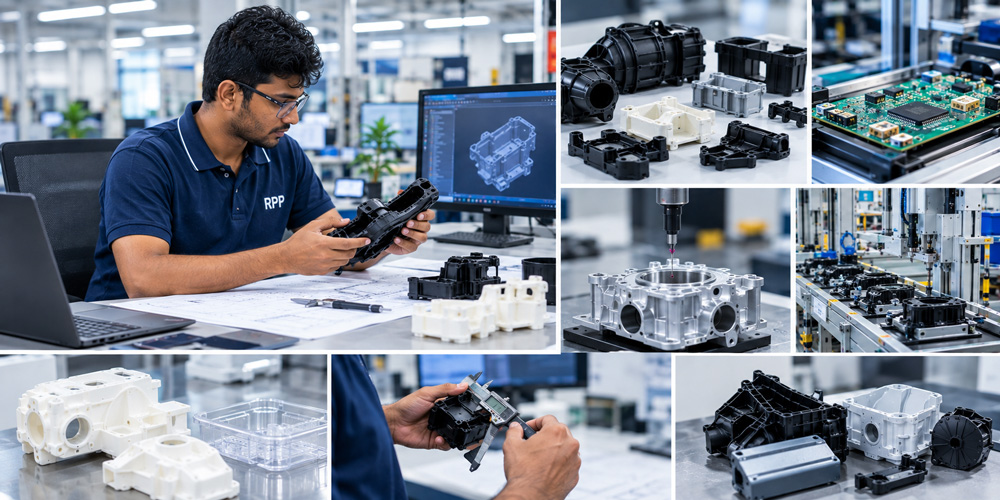
Engineering Across Sectors

Industries We Serve

Engineering-led plastics solutions for industries where development, precision and manufacturing responsiveness are critical.

Engineering Solutions Across Demanding Industrial Applications

RP Polymers works across industries where plastic components must be developed, adapted or manufactured around specific technical requirements rather than purchased as standard products. Our capabilities support customers from early product development and localization through prototyping, validation and repeatable production.

Automotive remains our primary strategic sector, while our thermoforming, additive manufacturing, 3D scanning and engineering capabilities also support industrial machinery, electronics, HVAC and appliances, medical and laboratory applications, construction interiors and other specialized manufacturing programs.

We exist to provide great careers

We Share Your Vision For What’s Important.

We are focused on doing what is right – for our people, for our clients, for our communities, and for the planet. And we are building today to transform tomorrow through our commitments. If you share our core values – commitment, integrity, and teamwork.

Automotive & Mobility

RPP supports automotive development and localization programs involving interior components, protective parts, fixtures, trays, dunnage and specialized plastic components. Our engineering-led workflow is suited to projects requiring reverse engineering, rapid validation, design adaptation, tooling flexibility and controlled low-to-medium-volume production programs.
Industrial Manufacturing & Machinery

We support manufacturers of machinery, automation systems and custom equipment with plastic guards, covers, housings, replacement components and development parts. RPP is particularly suited to non-standard requirements where existing components are obsolete, difficult to source or need redesign for local manufacturing.

Electronics & Precision Assemblies

RPP develops protective trays, component carriers, housings, handling solutions and prototype parts for electronics, sensors and precision assemblies. Our capabilities are valuable where geometry, repeatability and careful component handling matter, with future scope for more specialized ESD-controlled applications as systems mature.
HVAC, Refrigeration & Appliances

Thermoforming and additive manufacturing can support formed liners, covers, housings, service components, prototypes and replacement parts for HVAC, refrigeration and appliance manufacturers. RPP offers a flexible development route for moderate-volume components where tooling speed, design changes and local supply responsiveness are important.
Medical & Laboratory

RPP can support development-stage medical and laboratory applications including prototype components, device carriers, non-sterile trays and protective inserts. This sector is approached selectively, with solutions limited to applications that match current quality capabilities and without implying sterile, cleanroom or certified medical manufacturing.
Construction, Interiors & Specialized Applications

RPP supports project-specific interior panels, access covers, enclosures, equipment housings, liners and other custom formed components for construction, commercial interiors and specialized applications. These projects are most attractive where unique geometry, moderate volumes and development support make standard off-the-shelf solutions unsuitable.

BENEFITS

Why Manufacturers Choose RPP Across Demanding Industrial Programs

RPP combines digital development tools, plastics manufacturing capability and collaborative engineering support to help customers reduce development friction, manage tooling decisions, improve manufacturability, respond to changing requirements and build more reliable local supply pathways across demanding industrial programs.

01. Faster Development Cycles 02. Lower Tooling Risk 03.Engineering Collaboration 04. Flexible Production Volumes 05. Localization Support 06. Prototype-to-Production Continuity
1. Faster Development Cycles

Combining scanning, design support, SLA prototyping and thermoforming allows development work to progress through fewer disconnected suppliers. Customers can review geometry, test fitment, refine designs and move toward tooling or production more quickly, helping reduce delays during localization, new product introduction and engineering change programs while requirements are still evolving.

Lower Tooling Risk

RPP’s development approach helps customers validate component geometry and application requirements before committing to higher-cost production tooling. Rapid prototypes, tooling masters and pilot builds create opportunities to identify design issues earlier, make revisions at lower cost and select a manufacturing route that better matches expected production volumes and program maturity.
Engineering Collaboration

Projects are approached as engineering and manufacturing problems rather than simple part orders. RPP works with customer teams to understand application requirements, existing geometry, materials, manufacturability and finishing needs, helping translate incomplete or evolving requirements into practical solutions that can be validated, refined and prepared for production with clearer shared technical expectations.
Flexible Production Volumes

Thermoforming and additive manufacturing are particularly useful where quantities do not justify conventional high-investment tooling or where demand is still developing. RPP can support prototypes, validation quantities, pilot batches and selected low-to-medium-volume production, giving customers greater flexibility as programs progress from development toward repeatable supply without prematurely committing to high-volume production economics.
Localization Support

RPP helps manufacturers reduce dependence on difficult-to-source imported plastic components by supporting component capture, reverse engineering, design adaptation and local manufacturing development. This is especially valuable for obsolete parts, low-volume components and applications where overseas minimum order quantities, long lead times or changing designs create recurring supply challenges and weaken supply continuity.

Prototype-to-Production Continuity

Customers can progress from early geometry capture and design work through prototypes, validation, tooling decisions and production support within one coordinated development pathway. Maintaining continuity between these stages reduces information loss, improves learning from each iteration and helps establish more structured, repeatable manufacturing once the design has been approved by the customer team.
Start A Conversation

Discuss Your Application With Us

Share your component, drawing or application requirement with our team to discuss feasibility, development approach and the most suitable manufacturing route.

Call Me Back

Send Email Us

x

Call Me Back

Send us a message and we will reply you within 3 hours by email.


    x

    Send Email Us

    Send us a message and we will reply you within 3 hours by email.


      Select the fields to be shown. Others will be hidden. Drag and drop to rearrange the order.
      • Image
      • SKU
      • Rating
      • Price
      • Stock
      • Availability
      • Add to cart
      • Description
      • Content
      • Weight
      • Dimensions
      • Additional information
      Click outside to hide the comparison bar
      Compare